There is a moment in the history of an idea when the friction of expressing it disappears. Photography after the Brownie. Music after GarageBand. Writing after the word processor. In each case, a slow priestly craft — held by a small number of trained hands, gated by equipment, guarded by guilds — gave way to something faster, looser, more democratic. The work didn't get easier. The threshold to begin did.
For most of financial history, creating a tradeable market on something — anything — has been the privilege of an exchange. To list a market, you need a clearinghouse, a regulator, a counterparty, a settlement layer, and a quorum of traders interested enough to provide liquidity. The infrastructure of a single futures contract represents centuries of accumulated institutional plumbing. The barrier to *creating* a market has always been astronomically higher than the barrier to *trading* one — and that asymmetry has shaped which questions the world gets to bet on, and which it doesn't.
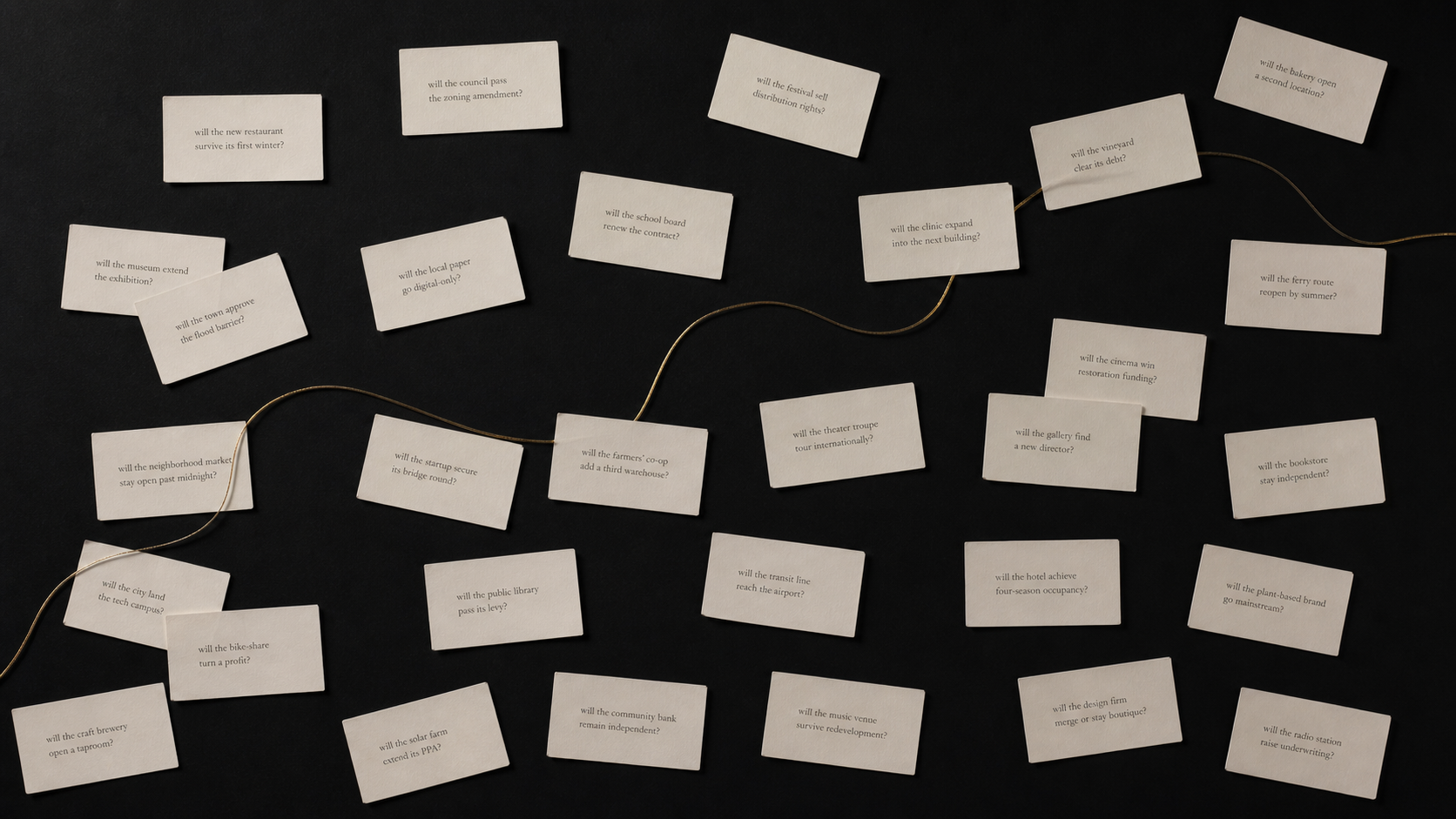
A market on the U.S. presidential election? Of course. A market on the Federal Reserve's next rate decision? A few of those exist. A market on whether your local council will pass a zoning amendment in time for the next building cycle? On whether your friend's startup will hit a million in revenue by year-end? On whether the new restaurant in your neighborhood will survive its first winter?
Those markets don't exist because no exchange has ever found it worth listing them. Not because the questions aren't interesting, or because no one would trade them. Because the cost of creation has always been higher than the value of any single niche question.
We think that asymmetry is about to invert.
The shape of the inversion
Embersity is, today, a leveraged prediction market with a working AI market-creation pipeline. Type a prompt. The system validates it, drafts a binary market with rules and resolution sources, and shows you the result. Most of it works. Some of it doesn't, yet. None of it is what we mean when we talk about what this becomes.
What we mean is this. A user has a thought. They open a text field. They type, in the same way they'd type a search query or a tweet: *will the new Apple Vision launch outsell the AirPods Max in its first month?* They hit return.
Within seconds, the system has done a remarkable amount of work on their behalf. It has parsed the question for ambiguity, surfaced the implicit comparisons (over what time window? in what units — revenue or units shipped? including refurbished or new only?), and drafted a precise version that strips the ambiguity without changing the user's intent. It has identified the resolution sources — a quarterly earnings call, an industry tracker, a publicly verifiable data feed — and selected the one with the cleanest paper trail. It has written the resolution rules in a style that a hostile reader couldn't dispute. It has drafted a description that makes the market readable to someone who arrived from a link without context. It has selected an image. It has set defaults for the close date, the resolution window, the dispute period, the fee structure. It has done what a market designer with a financial-engineering background would do, except in the time it takes to read this paragraph.
The user sees a draft. They make two small edits — adjust the close date, swap the image for one they prefer. They publish. The market is live. Other users can trade it.
The user has just done the work of an exchange.
Why this is different from "AI assistance"
The temptation, watching language models eat one workflow after another, is to think of AI as *assistance* — a copilot, a faster typist, an autocomplete for thoughts you would have had anyway. That framing undersells what's happening.
What's happening is that an entire layer of expertise — the layer that translates a vague human intuition into a precisely specified instrument with rules and a resolution mechanism — is becoming a service callable from a text input. The expertise hasn't disappeared; it's been compiled into a system that can apply it on demand. The human still has to *want* the market to exist. They no longer have to know how to build it.
The implication is not that markets become easier to make. The implication is that the *bottleneck shifts* — from the supply side (who can create) to the demand side (what's worth creating). The interesting question stops being "can you create a market on this?" and becomes "is this market worth creating?" That's a much better question to be the bottleneck. It selects for taste, knowledge, and proximity to the underlying event — exactly the qualities that make for valuable markets in the first place.

What this enables, end-to-end
When the friction of creation drops, the *kinds* of markets that can exist change. This is the part most discussions of AI in finance get wrong — they imagine the same markets, generated faster. The actual frontier is markets that couldn't have existed before because they were too small, too local, too niche, or too time-sensitive to justify the human labor of designing them.
Consider a few examples that are not currently markets, but will be.
A film festival announces its slate. Within an hour, dozens of markets exist on each premiere — will *X* win the audience award, will *Y* sell distribution rights at this festival, will *Z* be the highest-grossing of the festival's films within a year. The film community trades them. The market resolves to public information that everyone in the community already follows.
A new biotech reports preliminary data. A market on whether the pivotal trial succeeds is live within minutes. The trial isn't the asset; the *forecast of the trial outcome* is. Pharma analysts who would otherwise express their views in private memos can express them in a market with skin in the game.
A city council schedules a vote on a zoning ordinance. The local development community — architects, builders, brokers, residents who care — trades the outcome. The market is small, hyperlocal, and deeply informative because the people trading it actually know things. When it resolves, the price history becomes a public record of how local sentiment evolved.
A friend bets a friend on a sports outcome. Instead of a Venmo IOU, they create a market between themselves with two participants. The market exists, the trade is collateralized, the resolution is automatic. A casual bet has the structural cleanliness of a financial instrument, with none of the friction.
These are not gimmicks. They are the natural consequence of dropping the cost of creation toward zero. The world is full of questions whose answers would benefit from being priced in real time, by people who know things, with money on the line. Today, almost none of those questions get the market they deserve. We're building toward a future in which most of them will.
The technical underpinning, briefly
The current pipeline does cheap local validation first — rejecting prompts that are too vague to resolve, repairing prompts that have a clear intent but ambiguous specification, suggesting clarifications via clickable chips when something is fixable. Only valid, well-formed prompts reach the model. When the model is called, the result is structured: question, description, Yes/No outcomes, resolution rules, source links, market imagery. The result is cached so identical prompts don't burn tokens twice.
That's the floor. The ceiling, the version we're working toward, looks like this.
A reasoning layer that doesn't just draft a market — it *negotiates* one. The user types something vague. The system asks one or two precise clarifying questions, the way a good editor would. The resulting market is not just specified, it's *thought through*, with edge cases handled and ambiguity priced into the rules.
A resolution layer that watches its own sources. The market doesn't just point at a news article and hope for the best. It monitors the source, detects the resolution event, and proposes a settlement that the dispute-resolution layer can validate or override. The market settles itself, with humans in the loop only when the data is genuinely unclear.
An imagery layer that generates the visual identity of the market on the fly. Every market has a distinct image — generated, not stock — that captures something specific about the question. The market for the Apple Vision launch shows a Vision. The market for the Fed cut shows a Fed building. The market for your friend's startup shows their logo. The visual layer is part of how markets become legible to people who didn't create them.
A discovery layer that surfaces newly-created markets to the people most likely to care. A new local zoning market should reach the architects and brokers who care about it, not the broader feed. Recommendation in markets is a fundamentally different problem from recommendation in content, because the value of a recommendation is whether the user *should be trading* the market, not whether they'll watch a 30-second video of it. Solving this is its own discipline.
A creator layer that pays the people who make valuable markets. On Embersity, a market creator earns 50% of every trade fee that market generates, forever. As the cost of creation drops, the value of *good* creation rises. The people who consistently identify markets worth trading become a class of market entrepreneurs in their own right — earning real money for the work of recognizing what's worth pricing.
What we're really building
A leveraged prediction market on a few high-attention events is a useful product. A platform on which anyone can mint a market on anything they care about, in seconds, with leverage, with a creator economy that rewards the people who make markets worth trading — that's a different kind of object. That's an unbundling of the exchange.
For four hundred years, the function of an exchange has been to host markets. The exchange chose which markets to list, who could trade them, what rules they obeyed, and how they resolved. That function isn't going away. It's going to stop being centralized.
We are early in this transition, and we are not the only ones building toward it. Other platforms will solve adjacent pieces — different focus areas, different leverage profiles, different creator economics. That's good. The transition is too large for any single platform to define. What we are committed to is making the *creation moment* — the moment between a human having a thought and a tradeable market existing in the world — as close to instantaneous and as close to free as the technology will allow.
If we get this right, the question of what's worth pricing will be answered, increasingly, by the people closest to the events themselves. Not by exchange product managers. Not by financial-engineering committees. By film critics, biotech analysts, local builders, sports fans, friends settling bets at dinner.
That's the version of this we're building toward. The product that exists today is the on-ramp.
Embersity offers up to 5× leverage on any market, AI-generated markets in seconds, and 50% creator fees forever for whoever creates a market. Closed beta is open.